



Skip to the main content.

Green Leaf FV Recycling Favicon-1

FV Recycling is your all-in-one
industrial & commercial recycling solution.

Sign Up

Sign up for monthly notifications from FV Recycling to stay up-to-date on news, events, education and more.

Green Leaf FV Recycling Favicon-1

Cost Efficient. Green Effective.

7 min read

Cardboard Baler and Compactor Preventive Maintenance: A Complete Guide

Cardboard Baler and Compactor Preventive Maintenance: A Complete Guide
9:50

A baler or compactor that's well-maintained quietly does its job for years. One that's neglected tends to fail at the worst possible moment - usually mid-shift, with a full charge of material and a line of carts backing up behind it. The difference between those two outcomes rarely comes down to luck. It comes down to whether someone is following a maintenance schedule.  The good news is that the schedule isn't complicated, and most of it can be done by your own team in a few minutes a day.


This guide walks through what preventive maintenance actually involves for both balers and compactors, why it pays off, and the day-by-day checklists you can hand to an operator and start using this week.

What Is Preventive Maintenance for a Cardboard Baler or Compactor?

Preventive maintenance (PM) is scheduled, routine servicing performed at fixed intervals (daily, weekly, monthly, or annually) to keep equipment running and catch wear before it causes failure. It's the opposite of reactive maintenance, where you only touch the machine after it breaks.

For both balers and compactors, preventive maintenance focuses on four systems:

  • The hydraulic system — the pump, cylinders, hoses, and fluid that drive the ram.
  • The structural components — the frame, welds, and chamber that take the load.
  • The electrical controls — buttons, limit switches, photo eyes, and the control cabinet.
  • The safety devices — interlocks, guards, and emergency stops.

The exact tasks and intervals vary by manufacturer and model, so your machine's manual is always the final word. But almost every PM program follows the same rhythm: short daily inspections that an operator can do at startup, slightly deeper weekly and monthly checks, and a comprehensive annual service. When done consistently, this approach keeps the machine safe to use and extends its lifespan before major repairs or replacement.

Get more from every bale of cardboard. Talk to a recycling expert!

Why Does Cardboard Baler and Compactor Maintenance Matter?

Skipping maintenance is far more expensive than doing it, and the costs show up in three places: lost production, repair bills, and worker safety. The third one is the reason this isn't optional.

On the financial side, a small problem caught early is cheap; the same problem caught after it fails takes the machine out of service, backs up your material handling, and turns a filter swap into a hydraulic rebuild. The operations that run a structured maintenance program simply break down less and recover faster when they do.

Safety is the bigger story with this equipment. Balers and compactors combine high hydraulic force, heavy moving rams, and stored energy, which makes them dangerous to service without the right precautions. These machines have caused serious crush injuries when they restart unexpectedly during service, which is exactly why lockout/tagout and interlock checks belong in the routine, not in a binder nobody opens.

Baler vs. Compactor: What's the Difference?

A baler compresses loose material into a tied, stackable bale, while a compactor crushes waste into a container for hauling. Both use hydraulic rams, and both follow nearly identical maintenance routines, but they handle material differently, and that's worth understanding before you set up a PM plan. All of these fall under the broader category of compaction equipment.

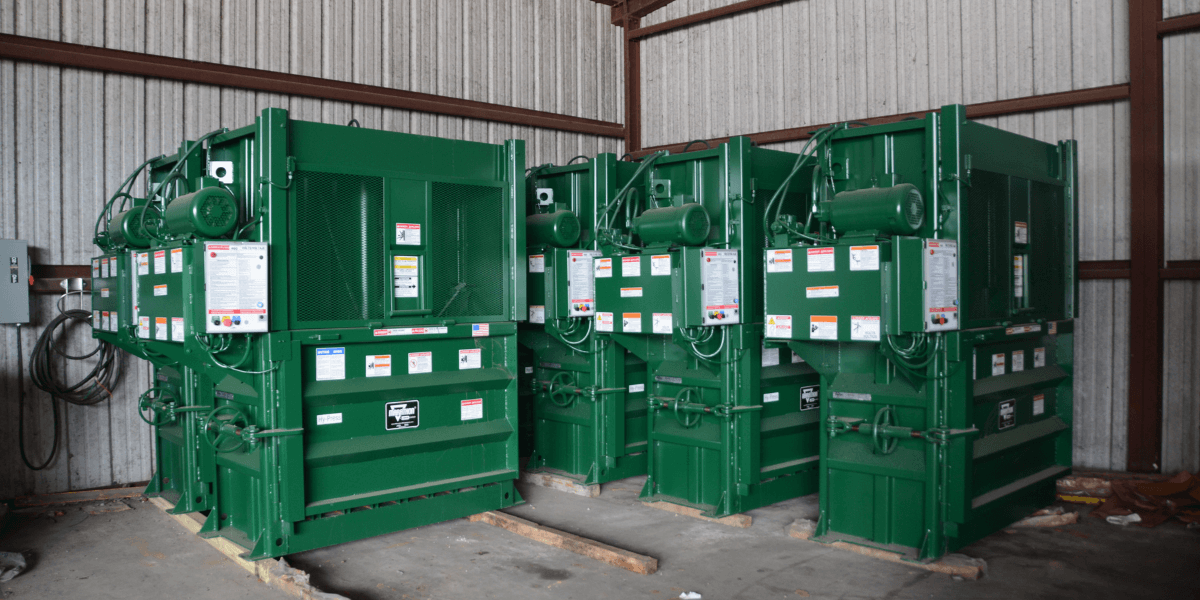
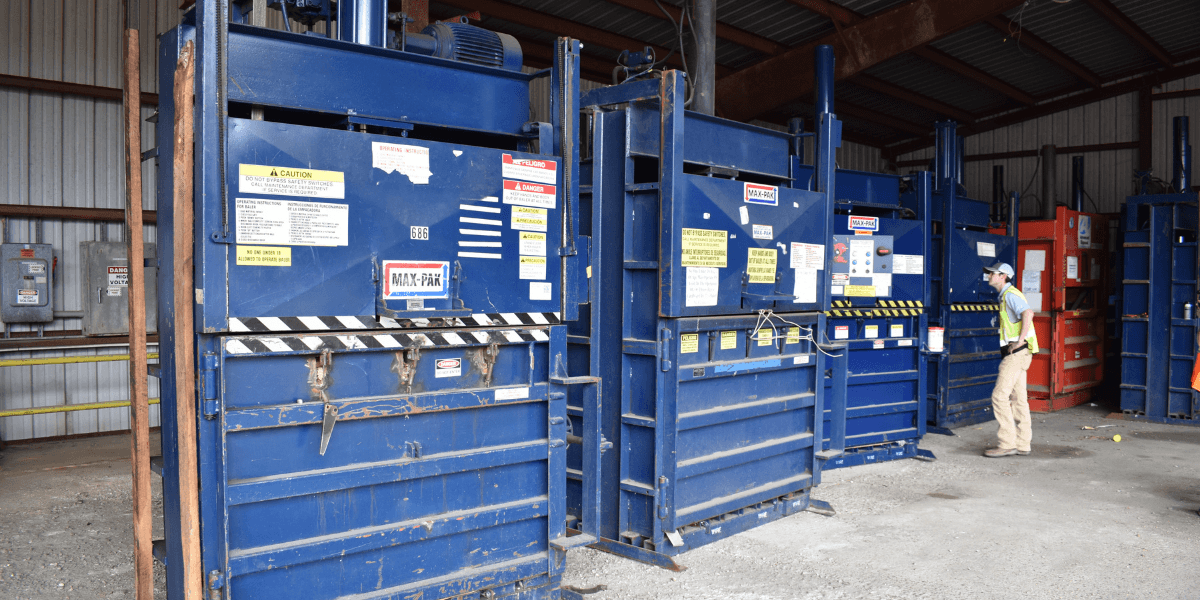
Vertical Cardboard Baler

A vertical cardboard baler loads from the front and presses material downward into a chamber; when the chamber is full, the operator ties off a bale and ejects it. It produces a tied bale of compressed cardboard from the front of the machine, which makes it the workhorse for most commercial back-of-house operations.

  • Inspect bale straps,bale wire guides, and the tying mechanism daily — faulty tying is a common failure point.
  • Keep an eye on the ram guides and wear pads that take the friction of the downward stroke.

Horizontal Cardboard Baler

A horizontal cardboard baler feeds material in from the side or top, often automatically, and is built for higher volumes. The result is a larger, denser bale produced at a greater throughput than a vertical unit can manage.

  • Check conveyor or auto-feed systems regularly, since they add moving parts a vertical baler doesn't have.
  • Inspect the longer ram stroke for alignment and wear-pad condition, both of which take more abuse at high volume.

Compactor (Stationary or Self-Contained)

A compactor crushes waste into an attached container that gets emptied by a hauler rather than producing a tied bale. Stationary units pack into a detachable container, while self-contained units seal the compactor and container together for wet or messy waste.

  • Clear guide rails and the charge-box area daily so debris doesn't jam the ram path.
  • Inspect the container-to-compactor connection and, on self-contained units, the seals — leaks here create both a mess and a hazard.

How Often Should You Service a Baler or Compactor?

A baler or compactor needs daily operator inspections, weekly and monthly checks by trained staff, and a comprehensive professional service once a year. Heavy-use machines running multiple shifts may need the monthly tasks moved up to a shorter interval.

Interval

Core tasks

Who typically does it

Daily

Clear debris, check for leaks, test safety interlocks, and the e-stop before each shift.

Trained machine operator

Weekly

Check fluid level, inspect hoses and wear pads, lubricate grease points per the manual.

In-house maintenance staff

Monthly

Tighten fasteners and electrical connections, verify ram alignment, inspect welds and limit switches/photo eyes.

In-house maintenance staff

Quarterly / semiannual

Replace or clean hydraulic filters, check oil for contamination, inspect couplings and seals, test all safety circuits.

Maintenance staff or service contractor

Annual

Full hydraulic inspection, oil change if required, replacement of worn wear pads and seals, complete structural and safety audit.

Qualified service technician

Which Wear Items Should You Watch and Replace?

Certain parts wear out on a predictable cycle, so keeping a few on the shelf turns a multi-day repair into a same-day fix. Stocking common wear items is one of the cheapest ways to reduce downtime.

The parts that most often need periodic replacement on balers and compactors are:

  • Hydraulic hoses, which crack and abrade over time and can fail under pressure.
  • Hydraulic filters, which clog and must be changed to keep oil clean.
  • Cylinder seals, which wear and start to leak, causing weak or slow ram movement.
  • Door seals and gaskets, especially on self-contained compactors where leaks create a mess and a hazard.
  • Limit switches and photo eyes, which control ram position and safety functions and degrade with use.
  • Wear strips and guide shoes, which take the friction of the moving ram and protect the frame.
  • Electrical relays and contactors, which switch the high-current circuits and eventually burn out.

Track when you replace each of these in your maintenance log. Over a year or two, the log shows which parts wear fastest on your specific machine, so you can order ahead and never get caught waiting on a part with the equipment down.

How Do You Service a Baler or Compactor Safely?

Never service a baler or compactor without completing lockout/tagout first - the stored hydraulic and electrical energy in these machines can kill. This is the single most important rule in this entire guide.

Lockout/tagout (LOTO) is the procedure for shutting down a machine, isolating its energy sources, and preventing it from restarting while someone is working on it. OSHA requires it under its control-of-hazardous-energy standard, and it's been used on balers and compactors for decades because these machines have caused serious crush injuries when they restart unexpectedly.

NIOSH lays out the steps in its guidance on preventing injuries while compacting or baling: disconnect the power, lock the disconnect, tag it so others know to leave it off, mechanically block any ram that could move, and test the controls to confirm the machine is truly de-energized before you begin. Guards and interlocks must be maintained to the manufacturer's specs and never bypassed.

Before any maintenance, always follow LOTO, disconnect and isolate electrical power, relieve stored hydraulic pressure, secure the ram against movement, and wear proper PPE — safety glasses, gloves, and steel-toe footwear.

Who Should Service Your Cardboard Baler or Compactor?

FV Recycling. Keeping baler and compactor maintenance on schedule is a core part of what we do for commercial and industrial operations across the Southeast, Midwest, and Southwest — not a side service we bolt on. We've seen firsthand what neglected hydraulics and worn parts do to a commercial waste management program, so we build maintenance around two goals: keeping your equipment running and keeping your bales dense enough to hold their value.

When you work with us, we can:

  • Set up and run a preventive maintenance program tailored to how hard you run your equipment, from daily operator checklists to the annual service.
  • Handle the deeper service work — hydraulic inspections, seal and wear-part replacement, and full safety audits — that's best left to a qualified technician.
  • Repair, lease, sell, or buy back equipment when a machine reaches the end of its useful life, so a breakdown never has to stall your operation.

Whether you're running a single vertical baler or compaction equipment across multiple sites, we'll keep it serviced, safe, and earning its keep.

Reach out to FV Recycling to set up a maintenance plan or schedule service.

New call-to-action

Frequently Asked Questions