

Our Baler Keeps Jamming — The 5 Most Common Causes and Fixes
A jammed cardboard baler doesn't just slow down your operation; it costs you time, money, and efficiency across your entire commercial waste...
![]()
Sign up for monthly notifications from FV Recycling to stay up-to-date on news, events, education and more.
![]()
5 min read
FV Recycling
:
Apr 20, 2026 1:00:12 PM
Table of Contents
|
Baler and compactor failures in commercial and industrial environments typically follow a predictable pattern: gradual performance decline, an increase in minor jams or errors, and then a full stoppage. Understanding what type of service you need, who can provide it, and when to escalate from repair to replacement helps facilities avoid extended downtime and manage equipment costs more effectively. |
This guide covers the scope of baler and compactor servicing, response expectations, rental considerations, the repair-vs.-replace decision, and preventative maintenance, all based on FV Recycling's direct experience servicing commercial recycling equipment across the Southeast, Midwest, and Southwest.
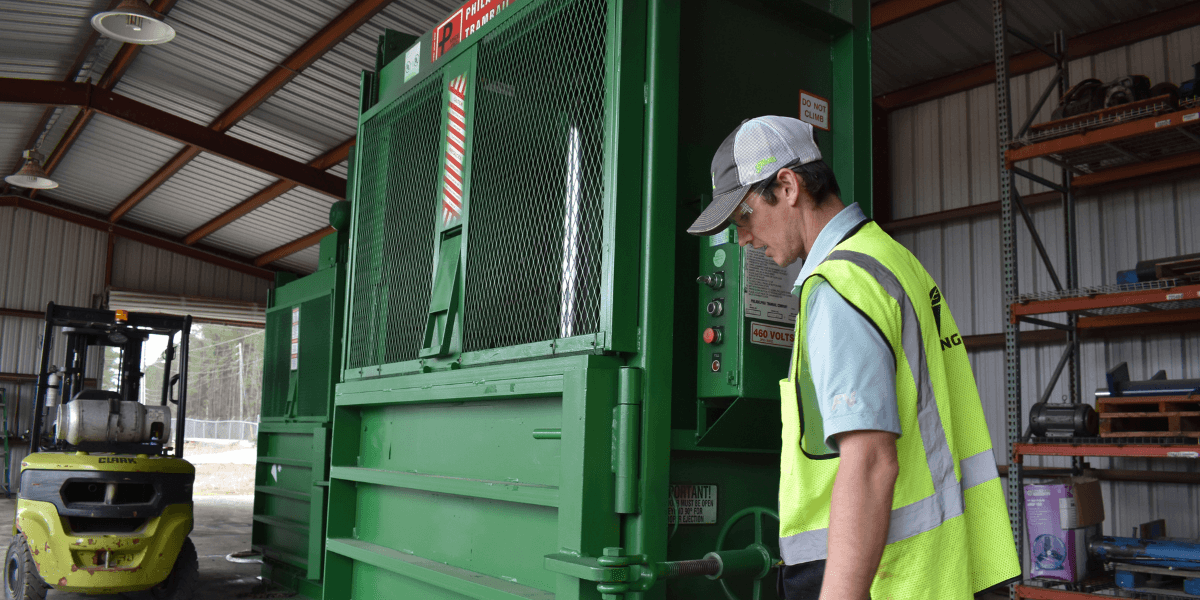
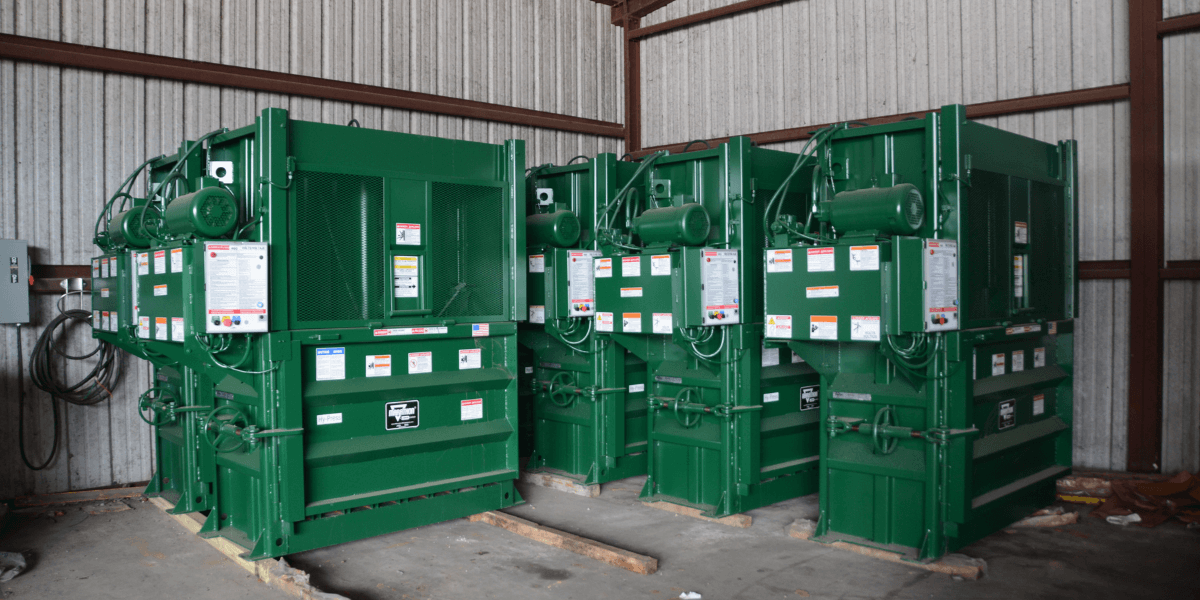
FV Recycling services vertical balers, horizontal balers, self-contained compactors, and stationary compactors across multiple brands, including equipment not originally sold or leased through FV.
Our technicians are trained on the following brands:
Service work includes hydraulic system diagnosis and repair, electrical and control panel troubleshooting, ram seal and platen pad replacement, bale wire system adjustments, and general mechanical repairs. For brands not listed above, contact FV directly to confirm service availability for your specific make and model.
BRANDS WE SUPPORT
FV Recycling offers same-day and next-day service in many areas of its service territory, with 24/7 emergency support for complete operational stoppages. Response time depends on technician proximity and whether specific parts need to be sourced before the visit.
When contacting FV for a service call, having the following information ready reduces time to diagnosis:
This information allows the dispatcher to determine whether the visit is a standard service call, whether specific parts should be brought on-site, or whether a preliminary remote diagnosis is possible before the technician arrives.
When a repair requires fabricated or special-order components, a short-term baler rental is the standard solution for maintaining operational continuity while the primary machine is down. Most baler repairs are completed during the initial service visit, but extended repairs can leave a facility without a functional baler for multiple days.
FV Recycling provides short-term baler rentals for facilities that need to continue processing cardboard and recyclable materials during a repair window.
Key considerations for rental:
The repair-vs.-replace decision is primarily a cost-per-year analysis: repair is appropriate when the total cost is low relative to the machine's remaining useful life, and replacement or leasing becomes the stronger option when repair costs are recurring, parts are difficult to source, or the machine's capacity no longer matches current volume.
The machine is under 10 years old and has no recurring fault history
The failure is isolated — a specific component rather than systemic degradation
Repair cost is below 30–40% of current replacement value
Parts are available and lead times are short
Add your content here.
Repair frequency has increased — more than one significant service call per year
The machine is over 12–15 years old and showing multiple wear points simultaneously
Cumulative repair costs over the past two years approach or exceed the cost of a lease
Facility volume has grown and the current machine is consistently running at or above rated capacity
Replacement parts are obsolete or require extended lead times that create operational risk
Add your content here.
FV Recycling's equipment team can provide a straightforward assessment of whether repair or replacement is the more cost-effective path for a specific machine. This evaluation is based on the equipment's service history, current market value, and available replacement options, not a sales objective.
A standard baler preventative maintenance visit covers hydraulic system inspection, hose and fitting checks, ram seal and cylinder condition, bale wire system adjustment, electrical and control panel review, structural integrity assessment, and lubrication of all moving components per manufacturer specifications.
Scheduling routine maintenance is more cost-effective than emergency repair in both direct cost and operational disruption — the majority of common baler failures are preventable with consistent servicing intervals.
A standard preventative maintenance visit covers:
Recommended service intervals vary by machine type and volume. As a general baseline, high-volume operations (processing multiple bales per shift daily) should schedule preventative maintenance every 3–4 months. Lower-volume operations may extend to semi-annual or annual intervals.
Industry note: The most common cause of premature baler failure is deferred maintenance on hydraulic systems.
Contaminated or low hydraulic fluid causes accelerated wear on pumps and cylinders — components that are
significantly more expensive to replace than routine fluid maintenance.
A multi-brand service provider like FV Recycling services equipment from multiple manufacturers under a single service relationship, while manufacturer service programs are typically limited to the brands they produce, often operate on longer scheduling windows, and may require equipment to be transported to a service center for non-field-repairable issues.
FV Recycling services equipment across multiple brands under a single service relationship. For facilities that have a baler from one manufacturer and a compactor from another — which is common — this consolidation reduces administrative overhead and provides consistent response times regardless of which machine needs attention.
FV's equipment service team also works within the context of a facility's broader recycling program. Service technicians can identify operational issues that aren't purely mechanical, like material preparation practices, bale density problems, or loading patterns that are accelerating wear, and flag them as part of a service visit.
A well-maintained commercial cardboard baler typically has an operational lifespan of 15–20 years. Lifespan varies based on daily cycle volume, material type, maintenance consistency, and operating environment. High-volume facilities running multiple shifts will see accelerated wear on hydraulic components, ram seals, and structural elements compared to lower-volume operations. Regular preventative maintenance is the primary factor in extending equipment life toward the upper end of that range.
Yes. FV Recycling offers scheduled preventative maintenance programs for commercial and industrial facilities. These programs establish regular service intervals based on machine type, daily cycle count, and material profile — reducing emergency repair frequency and providing more predictable equipment operating costs. Contact FV Recycling to discuss program options for your facility.
High-volume operations processing multiple bales per shift daily should schedule maintenance every 3–4 months. Lower-volume operations may extend to semi-annual or annual intervals. FV Recycling can recommend the appropriate interval based on machine type, daily cycle count, and material type.
Most standard baler service and repair visits are completed within a few hours. More complex repairs involving hydraulic cylinder replacement, control panel work, or structural components may require a full day on-site. If parts need to be ordered, a follow-up visit will be scheduled once components are available. FV Recycling's dispatch team can provide a time estimate when the service call is booked, based on the reported fault and equipment type.
A jammed cardboard baler doesn't just slow down your operation; it costs you time, money, and efficiency across your entire commercial waste...
In commercial waste management, efficiency isn’t just a nice-to-have—it’s essential. Whether you manage a warehouse, manufacturing facility,...
Facilities eventually reach a point where waste stops being a background expense and starts becoming an operational issue. When dumpsters fill...