



Do We Need a Baler or Compactor & How Do We Decide?
Facilities eventually reach a point where waste stops being a background expense and starts becoming an operational issue. When dumpsters fill...
![]()
Sign up for monthly notifications from FV Recycling to stay up-to-date on news, events, education and more.
![]()
7 min read
FV Recycling
:
Jun 15, 2026 5:09:42 PM
Table of Contents
|
A baler or compactor that's well-maintained quietly does its job for years. One that's neglected tends to fail at the worst possible moment - usually mid-shift, with a full charge of material and a line of carts backing up behind it. The difference between those two outcomes rarely comes down to luck. It comes down to whether someone is following a maintenance schedule. The good news is that the schedule isn't complicated, and most of it can be done by your own team in a few minutes a day. |
This guide walks through what preventive maintenance actually involves for both balers and compactors, why it pays off, and the day-by-day checklists you can hand to an operator and start using this week.
Preventive maintenance (PM) is scheduled, routine servicing performed at fixed intervals (daily, weekly, monthly, or annually) to keep equipment running and catch wear before it causes failure. It's the opposite of reactive maintenance, where you only touch the machine after it breaks.
For both balers and compactors, preventive maintenance focuses on four systems:
The exact tasks and intervals vary by manufacturer and model, so your machine's manual is always the final word. But almost every PM program follows the same rhythm: short daily inspections that an operator can do at startup, slightly deeper weekly and monthly checks, and a comprehensive annual service. When done consistently, this approach keeps the machine safe to use and extends its lifespan before major repairs or replacement.
Skipping maintenance is far more expensive than doing it, and the costs show up in three places: lost production, repair bills, and worker safety. The third one is the reason this isn't optional.
On the financial side, a small problem caught early is cheap; the same problem caught after it fails takes the machine out of service, backs up your material handling, and turns a filter swap into a hydraulic rebuild. The operations that run a structured maintenance program simply break down less and recover faster when they do.
Safety is the bigger story with this equipment. Balers and compactors combine high hydraulic force, heavy moving rams, and stored energy, which makes them dangerous to service without the right precautions. These machines have caused serious crush injuries when they restart unexpectedly during service, which is exactly why lockout/tagout and interlock checks belong in the routine, not in a binder nobody opens.
A baler compresses loose material into a tied, stackable bale, while a compactor crushes waste into a container for hauling. Both use hydraulic rams, and both follow nearly identical maintenance routines, but they handle material differently, and that's worth understanding before you set up a PM plan. All of these fall under the broader category of compaction equipment.
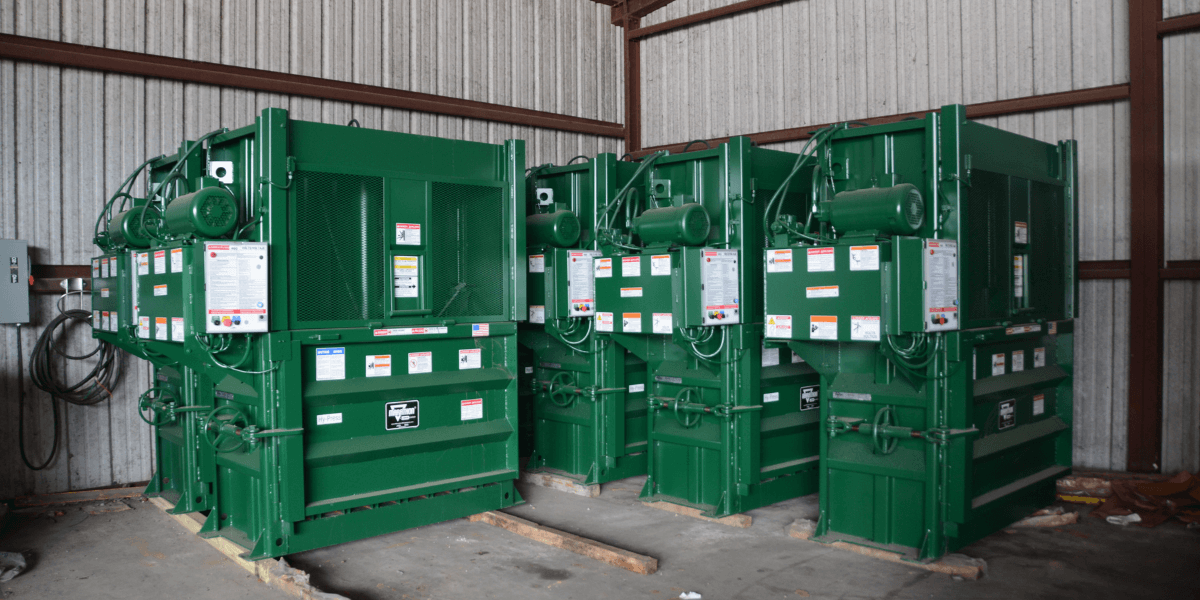
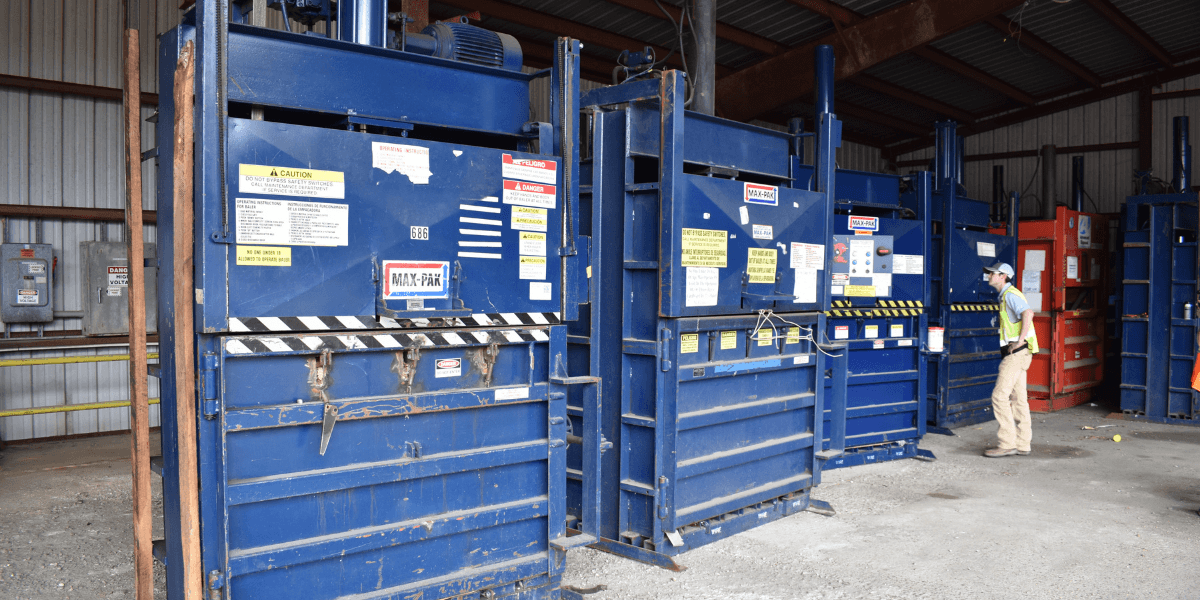
A vertical cardboard baler loads from the front and presses material downward into a chamber; when the chamber is full, the operator ties off a bale and ejects it. It produces a tied bale of compressed cardboard from the front of the machine, which makes it the workhorse for most commercial back-of-house operations.
A horizontal cardboard baler feeds material in from the side or top, often automatically, and is built for higher volumes. The result is a larger, denser bale produced at a greater throughput than a vertical unit can manage.
A compactor crushes waste into an attached container that gets emptied by a hauler rather than producing a tied bale. Stationary units pack into a detachable container, while self-contained units seal the compactor and container together for wet or messy waste.
A baler or compactor needs daily operator inspections, weekly and monthly checks by trained staff, and a comprehensive professional service once a year. Heavy-use machines running multiple shifts may need the monthly tasks moved up to a shorter interval.
|
Interval |
Core tasks |
Who typically does it |
|---|---|---|
|
Daily |
Clear debris, check for leaks, test safety interlocks, and the e-stop before each shift. |
Trained machine operator |
|
Weekly |
Check fluid level, inspect hoses and wear pads, lubricate grease points per the manual. |
In-house maintenance staff |
|
Monthly |
Tighten fasteners and electrical connections, verify ram alignment, inspect welds and limit switches/photo eyes. |
In-house maintenance staff |
|
Quarterly / semiannual |
Replace or clean hydraulic filters, check oil for contamination, inspect couplings and seals, test all safety circuits. |
Maintenance staff or service contractor |
|
Annual |
Full hydraulic inspection, oil change if required, replacement of worn wear pads and seals, complete structural and safety audit. |
Qualified service technician |
Certain parts wear out on a predictable cycle, so keeping a few on the shelf turns a multi-day repair into a same-day fix. Stocking common wear items is one of the cheapest ways to reduce downtime.
The parts that most often need periodic replacement on balers and compactors are:
Track when you replace each of these in your maintenance log. Over a year or two, the log shows which parts wear fastest on your specific machine, so you can order ahead and never get caught waiting on a part with the equipment down.
Never service a baler or compactor without completing lockout/tagout first - the stored hydraulic and electrical energy in these machines can kill. This is the single most important rule in this entire guide.
Lockout/tagout (LOTO) is the procedure for shutting down a machine, isolating its energy sources, and preventing it from restarting while someone is working on it. OSHA requires it under its control-of-hazardous-energy standard, and it's been used on balers and compactors for decades because these machines have caused serious crush injuries when they restart unexpectedly.
NIOSH lays out the steps in its guidance on preventing injuries while compacting or baling: disconnect the power, lock the disconnect, tag it so others know to leave it off, mechanically block any ram that could move, and test the controls to confirm the machine is truly de-energized before you begin. Guards and interlocks must be maintained to the manufacturer's specs and never bypassed.
Before any maintenance, always follow LOTO, disconnect and isolate electrical power, relieve stored hydraulic pressure, secure the ram against movement, and wear proper PPE — safety glasses, gloves, and steel-toe footwear.
FV Recycling. Keeping baler and compactor maintenance on schedule is a core part of what we do for commercial and industrial operations across the Southeast, Midwest, and Southwest — not a side service we bolt on. We've seen firsthand what neglected hydraulics and worn parts do to a commercial waste management program, so we build maintenance around two goals: keeping your equipment running and keeping your bales dense enough to hold their value.
When you work with us, we can:
Whether you're running a single vertical baler or compaction equipment across multiple sites, we'll keep it serviced, safe, and earning its keep.
Reach out to FV Recycling to set up a maintenance plan or schedule service.
Most of it your team can handle. The daily and weekly checks — clearing debris, spotting leaks, testing interlocks — are built for a trained operator and take only a few minutes. The deeper quarterly and annual work, especially hydraulic service and seal replacement, is where a qualified technician earns their keep.
A practical split is in-house from daily through monthly, with the annual service contracted out.
A machine that's serviced on schedule commonly runs 15 to 20 years or more before it needs a major rebuild, while a neglected one can be worn out in a fraction of that. Clean hydraulic fluid, tight structure, and replaced wear parts are what stretch that lifespan.
The single biggest factor isn't the brand of the machine — it's whether someone is actually following the schedule.
Stop the machine and call for service if you see a visible hydraulic leak, a ram that moves slowly or stalls under load, unusual grinding or knocking, a safety interlock or e-stop that doesn't respond, or any cracked weld or structural member.
These aren't "finish the shift and deal with it later" problems — running through them risks both a bigger repair bill and a serious injury.
More than most operators expect. A baler with worn seals or low hydraulic pressure can't reach full compaction, which means lighter, looser bales — and lighter bales mean fewer tons per load and a smaller rebate when you sell the material. Keeping the hydraulics healthy protects both the volume you move and the value you capture from it.
Preventive maintenance runs on a fixed calendar — you service the machine daily, weekly, monthly, and annually whether or not anything looks wrong. Predictive maintenance adds monitoring, such as oil analysis or vibration readings, so you service a part based on its actual condition instead of the calendar. For most operations, a solid preventive program is the right foundation; predictive tools are a worthwhile add-on once the basics are consistent.
Facilities eventually reach a point where waste stops being a background expense and starts becoming an operational issue. When dumpsters fill...
Baler and compactor failures in commercial and industrial environments typically follow a predictable pattern: gradual performance decline, an...
For industrial businesses, efficient cardboard recycling is not just an environmental initiative, it’s an operational necessity. Managing bulk...