

Skip to the main content.

Green Leaf FV Recycling Favicon-1

FV Recycling is your all-in-one
industrial & commercial recycling solution.

Sign Up

Sign up for monthly notifications from FV Recycling to stay up-to-date on news, events, education and more.

Green Leaf FV Recycling Favicon-1

Cost Efficient. Green Effective.

4 min read

Understanding RISI's Geographic Regions for Recovered Paper Markets

RISI Geographic Regions Guide: North American Paper Pricing
7:12

If you've ever wondered how recycled paper prices are determined across North America, or why your OCC (Old Corrugated Containers) — the industry term for cardboard — might fetch different prices depending on whether you're in Chicago versus Los Angeles, you're about to get some clarity. The world of recovered paper pricing isn't just about supply and demand—it's about understanding the intricate geographic puzzle that Fastmarkets RISI has mapped out for the industry.


Request a Quote CTA with image of FV worker looking over recycling equipment.

What Exactly Is RISI, and Why Should You Care?

Fastmarkets RISI — often just called Fastmarkets — has been the go-to source for recovered paper pricing intelligence since the 1970s. It joins a lineage of respected pulp and paper industry (PPI) price reporting services, including Official Board Markets (OBM) and the well-known 'Yellow Sheet' assessments, that have long tracked containerboard and paper values.

 Originally known as RISI, this price reporting agency has been a leading provider of insight to the forest products industry for many decades, and for good reason—when you're dealing with thousands of tons of recovered materials worth potentially millions of dollars, you need someone keeping track of what things are actually worth.

Think of RISI as the financial weather service for the recycling industry. Just as meteorologists track temperature patterns across different regions, RISI tracks pricing patterns across different geographic markets. And trust us, the weather can change dramatically depending on where you are.

The Geographic Puzzle: Why Does Location Matter More Than You Think?

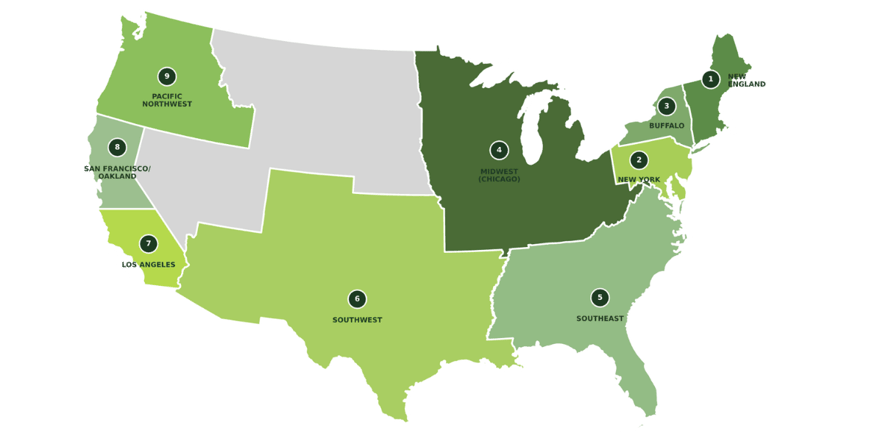
Here's where things get interesting (and slightly complex). North America isn't just one big, happy recycling market. It's a collection of distinct regional markets, each with its own supply chains, transportation costs, and local dynamics. RISI has divided the continent into nine distinct regions, and understanding these boundaries is crucial for anyone in the industrial cardboard recycling and commercial waste management game.

What Are RISI's Nine Regions?

RISI 9 regions. 

New England

The northeastern corner includes states like Maine, Vermont, New Hampshire, Massachusetts, Rhode Island, and Connecticut. This region typically sees higher transportation costs due to its distance from major West Coast ports, which affects export pricing.

New York

Gets its own category because, well, it's New York. The Empire State's massive population and industrial base create unique market dynamics that don't quite fit with neighboring regions.

Buffalo

This might seem oddly specific, but Buffalo serves as a crucial Great Lakes shipping hub. Its proximity to Canadian markets and strategic location for both domestic and international shipping justifies its separate designation.

Midwest (Chicago)

Centered around the Windy City, this region encompasses the industrial heartland of America. With major containerboard mills and excellent rail connections, the Midwest often serves as a pricing bellwether for the entire continent.

Southeast

Covering states from Virginia down to Florida and west to Louisiana, this region benefits from major ports like Savannah and Charleston, plus significant domestic paper manufacturing capacity.


Southwest

Texas and surrounding states form this region, with the Gulf Coast providing important export opportunities, particularly to Latin American markets.

Los Angeles

Like New York, LA gets its own category due to its unique position as the primary gateway to Asian markets. When China was actively importing recovered paper, LA pricing often drove national trends.

San Francisco/

Oakland

The Bay Area's ports complement LA's capacity, providing additional West Coast export options with their own market dynamics.

Pacific Northwest

Washington, Oregon, and parts of Northern California form this region, benefiting from proximity to Asian markets and significant local paper manufacturing.

How Does the RISI Market Actually Work?

Now that we've mapped the territory, let's talk about how this system actually functions. It's surprisingly sophisticated for an industry that many people think of as just "throwing stuff in trucks."

Data Collection: Who's Behind the Human Network?

RISI doesn't just make up numbers in a conference room (though that would be easier). Their reporters maintain relationships with producers, consumers, traders, and brokers across all these regions. They're constantly on the phone, gathering real transaction data, understanding market sentiment, and tracking shipment patterns.

The process is refreshingly analog in our digital age—much of the intelligence comes from actual conversations with people who are buying and selling materials. These aren't theoretical prices; they're based on what companies actually paid for materials in real transactions.

Monthly Assessments: Why Is Timing Everything?

RISI publishes most North American recovered paper prices monthly, typically around the 5th of each month at 3 PM Eastern Time. The assessment window includes orders taken from the beginning of the month through the assessment date, for shipment in the current month.

Here's where it gets nuanced: if market conditions are changing rapidly, RISI may also consider pricing data from the 20th of the previous month onward. This prevents sudden market shifts from being missed due to timing quirks.

Quality Control: Is All Data Created Equal?

RISI employs several quality controls that make their assessments more reliable, following industry best practices outlined by organizations like the Institute of Scrap Recycling Industries (ISRI) for transparent market reporting:

  • Volume weighting: Larger transactions carry more influence than smaller ones
  • Source diversification: No single data provider can contribute more than 25% to key benchmark prices (like OCC Midwest)
  • Transaction validation: Indexed prices, affiliated company transactions, and unusual circumstances are excluded

Why Do These Regional Differences Matter for Your Business?

If you're in the commercial cardboard recycling business, understanding these regional dynamics isn't academic—it's money in your pocket (or out of it). A load of OCC might fetch $120/ton in Los Angeles (where it can easily reach Asian buyers) while the same material in Buffalo might only bring $90/ton due to transportation costs to export markets.

This geographic granularity also helps explain why some curbside recycling programs work better in certain regions. Areas with strong local paper manufacturing (like the Southeast) often have more stable domestic demand, while regions dependent on exports face more volatility based on international trade dynamics.

What's the Broader Impact Beyond Just Pricing?

RISI's regional approach reflects a fundamental truth about recycling markets: all materials are local until they're not. Understanding these geographic patterns helps drive landfill diversion and supports:

  • Waste generators optimize their recycling collection and processing strategies
  • Haulers plan efficient transportation routes
  • Processors decide where to invest in recycling equipment and infrastructure
  • End users understand their supply chain risks

The beauty of this system is that it acknowledges the complexity of real-world markets while still providing the standardization needed for efficient trading. Organizations like the Recycled Materials Association (ReMA) advocate for this type of market transparency to support fair pricing across the industry.

Looking Forward: What Does Adaptation in Action Look Like?

The RISI methodology isn't set in stone. When China's National Sword policy dramatically reduced recovered paper imports in 2017-2018, RISI adapted by shifting export assessments from "China" to "non-China Asia." This flexibility ensures the pricing system remains relevant as market conditions evolve.

As we see growing domestic recycling infrastructure and changing trade patterns, these geographic definitions may continue to evolve. The key is maintaining the balance between regional specificity and practical usability.

Understanding RISI's geographic framework isn't just about knowing where lines are drawn on a map—it's about grasping the underlying economic forces that drive material values across our continent. Whether you're a small-town recycling coordinator or manage procurement for a major paper mill, these regional dynamics affect your bottom line every single day.

Ready to dive deeper into recovered paper markets?

Understanding regional pricing dynamics is just the beginning of optimizing your recycling management for maximum profitability and efficiency. Get with a member of our team today (sales@fvrecycling.com) to schedule cardboard pickup or recycling pickup, and discover how FV's commercial recycling services can make recycling work for you!

New call-to-action