

Skip to the main content.

Green Leaf FV Recycling Favicon-1

FV Recycling is your all-in-one
industrial & commercial recycling solution.

Sign Up

Sign up for monthly notifications from FV Recycling to stay up-to-date on news, events, education and more.

Green Leaf FV Recycling Favicon-1

Cost Efficient. Green Effective.

3 min read

Baler vs. Compactor vs. Open-Top: The Decision Guide

Table of Contents

Baler vs. Compactor vs. Open-Top: The Decision Guide
6:50


When companies begin thinking about recycling, or when they assess an existing program, the first question is often simple: What kind of equipment do we actually need? Should recyclable cardboard be baled, compacted, or simply placed in open containers for pickup?

The answer isn’t always obvious. Each approach has advantages depending on the size of the operation, the volume of material being generated, and how the facility handles its waste streams.

That’s where experienced recycling partners can make a difference. According to Tommy Griffin, Senior Operations Manager at FV Recycling, equipment decisions aren’t one-size-fits-all.

“It depends,” Griffin says. “Every facility is different. What matters is understanding the volume, the workflow, and how the customer operates day to day.”

Below is a practical guide to the three most common equipment options and how companies can determine which one makes the most sense.

The Baler: The Backbone of Most Recycling Programs

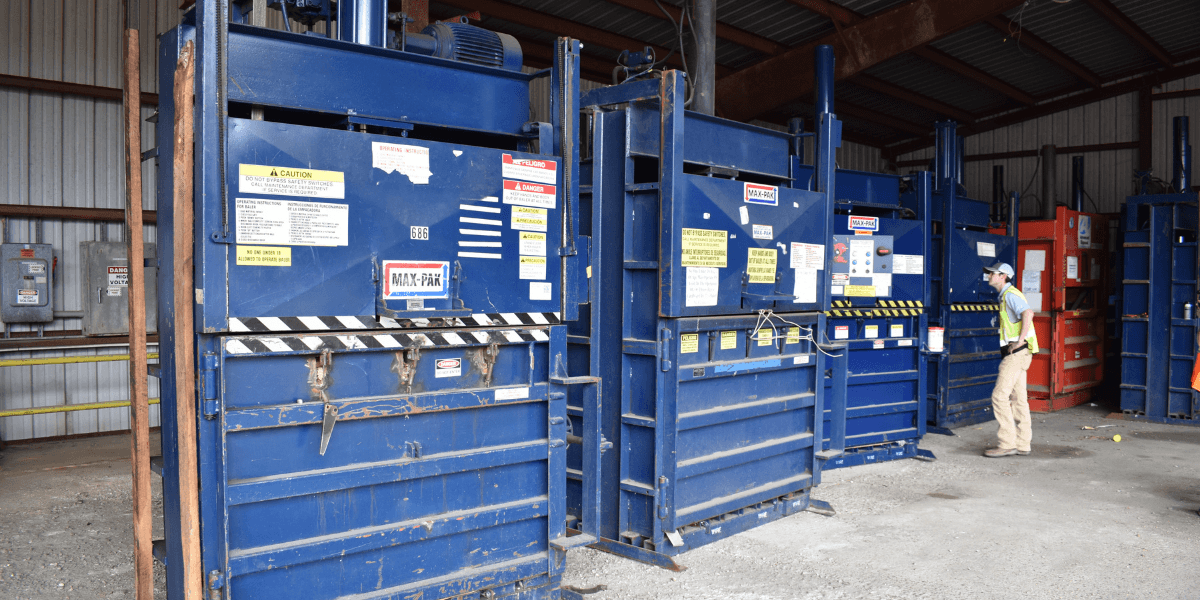
For most retailers and distribution facilities, the cardboard baler is the most common and effective equipment solution. Balers compress loose cardboard into dense, stackable blocks (called bales) that can be stored and transported efficiently.

According to Griffin, roughly 75–80% of FV Recycling’s equipment installations involve vertical cardboard balers, particularly in grocery stores and retail locations.

Here’s why they’re so common:

  • Higher material value: Baled cardboard is denser and cleaner than loose material, helping maximize commodity value when shipped to paper mills
  • Lower transportation costs: Dense bales allow trucks to carry significantly more material per load
  • Operational efficiency: Facilities can store multiple bales before pickup rather than requiring frequent waste hauls

Typical baler users include:

  • Grocery stores
  • Retail chains
  • Distribution centers
  • Packaging and converting plants
  • Manufacturing facilities

For larger industrial operations, horizontal balers may be used to handle much higher volumes automatically. But for most locations, the vertical baler remains the workhorse.

The Compactor: Best for Mixed Waste and Convenience

A compactor works differently. Instead of forming a bale, it compresses material into a container that is periodically removed and emptied.

Compactors are most commonly used for:

  • Food waste
  • Mixed trash
  • Facilities that want minimal employee interaction with equipment

Some companies also use compactors for cardboard when labor constraints or operational preferences make baling difficult.

For example, large facilities sometimes prefer compactors because employees don’t have to tie bales or manage stacked material.

“They may choose compactors simply because they don’t want employees tying off bales,” Griffin explains.

However, this convenience often comes with tradeoffs.

Because compacted cardboard isn’t as dense as baled material, trucks haul far less weight per load. This makes transportation less efficient and reduces potential commodity value.

For that reason, compactors are typically best suited for:

  • Food production and grocery waste streams
  • Mixed waste disposal
  • Facilities prioritizing convenience over material recovery value

Open-Top Containers: The Entry Point for Small Generators

For smaller businesses just getting into a recycling program, installing equipment may not always make sense. This is where open-top containers or bins come in.

These containers allow businesses to separate recyclable cardboard without purchasing or leasing machinery. A recycling partner simply swaps full containers for empty ones during scheduled pickups.

Open-top systems are often used by:

  • Small retailers
  • Convenience stores
  • Restaurants
  • Businesses generating relatively small volumes of cardboard

While simple, they also have limitations. Loose cardboard takes up much more space and weighs far less per load than baled material.

For growing companies, open containers are often a starting point, not the long-term solution.

Why the Right Equipment Matters

Choosing the right system affects far more than just recycling. It impacts:

  • Waste hauling costs
  • Labor efficiency
  • Facility space usage
  • Commodity revenue potential
  • Safety and workflow

In many cases, companies operate with equipment that isn’t optimized for their facility. FV Recycling frequently discovers opportunities to improve performance simply by evaluating how materials flow through a building.

Sometimes that means switching from compactors to balers. In other cases, it involves repositioning equipment, adding conveyors or handling equipment, or upgrading aging machines.

“Sometimes customers have that ‘aha’ moment when we conduct a review,” Griffin says. “They realize there may be a better way to move materials or handle the volume they’re generating.”

A Solution for Every Size Operation

One of FV Recycling’s strengths is the ability to support organizations across the entire spectrum, from small independent retailers to large industrial manufacturers.

For smaller businesses, equipment cost is often the biggest concern when starting a recycling program. That’s why FV Recycling frequently offers refurbished equipment and flexible leasing options to lower the barrier to entry.

A well-maintained baler can last 30 years or more, meaning refurbished equipment can still provide many years of reliable service.

Instead of requiring a large upfront investment, customers can often lease equipment for a manageable monthly cost. This allows them to begin baling cardboard and reducing waste disposal expenses at the same time.

“Rather than spending tens of thousands of dollars upfront, we can often put a customer into a baler for a modest monthly lease,” Griffin explains.

For many businesses, that makes the difference between simply throwing cardboard away and turning it into a structured recycling stream.

The Bottom Line

Whether it’s a baler, a compactor, or an open-top container, each option serves a purpose. The key is matching the equipment to the facility, the materials being generated, and the operational realities of the business.

That’s where experience matters. FV Recycling’s equipment specialists work closely with customers to evaluate material flows, recommend the right equipment, and support those systems over the long term.

Need Help Choosing the Right Equipment?

If you're launching a recycling program or wondering whether your current setup is working as efficiently as it could, FV Recycling can help.

Our equipment specialists can evaluate your operation and recommend the right solution for your facility. Contact us to start the conversation.

New call-to-action

FV Recycling: Your Go-To for Industrial Cardboard Recycling

FV Recycling: Your Go-To for Industrial Cardboard Recycling

For industrial businesses, efficient cardboard recycling is not just an environmental initiative, it’s an operational necessity. Managing bulk...

Read More
Do We Need a Baler or Compactor & How Do We Decide?

Do We Need a Baler or Compactor & How Do We Decide?

Facilities eventually reach a point where waste stops being a background expense and starts becoming an operational issue. When dumpsters fill...

Read More
Stretch Wrap vs. Shrink Wrap — Does It Matter Operationally?

Stretch Wrap vs. Shrink Wrap — Does It Matter Operationally?

Stretch wrap vs. shrink wrap does matter operationally because each material impacts speed, labor, safety, equipment, and recyclability...

Read More