

Our Recycler Won’t Accept a Material — What Are the Realistic Options?
When your recycler won't accept a material, you typically have six realistic options: find a specialized processor, improve source separation,...
![]()
Sign up for monthly notifications from FV Recycling to stay up-to-date on news, events, education and more.
![]()
3 min read
FV Recycling
:
May 1, 2026 11:55:59 AM
|
Commercial recycling proposals all look the same on paper. The difference shows up in year two — when pickups get missed, reports go dark, and nobody answers the phone. This guide walks through what actually separates a reliable recycling partner from one that looked good in the pitch. |
Not every recycling provider operates the same way — and that’s worth understanding before you sign. Some companies run their own trucks and crews directly. Others broker your service to whoever’s available in that market. Neither model is inherently wrong, but what matters is accountability: will someone actually own your account when something goes sideways?
At FV Recycling, we believe the strongest partnerships are built on visibility and access — not just proximity.
That means:
Reporting by location — pickups, commodity weights, and sustainability data broken out per site, so your team always has what they need for internal reporting or compliance
Real site visits from real people — our team members walk your floor, not just your contract. We help you optimize your space, right-size your equipment, and identify inefficiencies you may not have known existed
Multiple service offerings — from equipment and bale wire to trailer drops and equipment service, we’re set up to be a single point of contact across your operation
One thing worth asking any provider: do they have established, long-term relationships with end-users and mills? Mill closures happen — and they happen fast. A strong partner won’t leave you scrambling when a buyer closes their doors. Ask who their downstream partners are and how they’ve handled disruptions in the past. That answer tells you more than any coverage map.
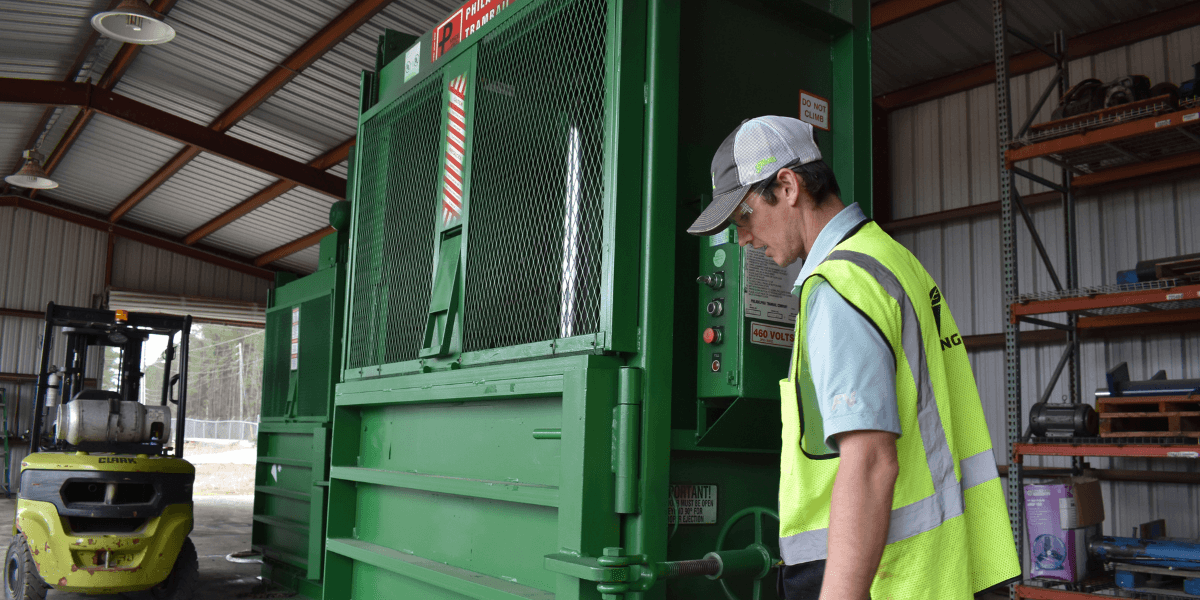
A capable recycling partner supplies and services equipment sized to your actual waste stream — not whatever’s sitting in their yard. For most commercial sites generating more than 400 pounds of fiber per day, a cardboard baler is the baseline: it compresses old corrugated containers (OCC) into mill-ready bales that ship more efficiently and earn stronger rebates than loose material hauled in open roll-offs.
A proper equipment plan is built around your tonnage data, not a generic volume bracket.
Expect recommendations that address:
Baler type matched to your daily throughput
Equipment sizing based on dock access and pickup frequency
Separate handling systems for plastic film, mixed paper, or metal where the volume supports it
Service response time commitments — in writing
Uptime is what separates a functioning program from a floor buried in loose boxes by Tuesday afternoon. FV Recycling has expert service teams located across multiple states, available for emergency repairs and ongoing recycling equipment support — and for higher-volume facilities, we can help you evaluate the leasing structure that best fits your operation
FV Recycling runs commercial and industrial recycling programs across the Southeast and Midwest — and following our acquisition of Mid America Paper Recycling, we significantly expanded our footprint and route density in Midwestern markets where multi-site operators previously struggled to find a single, integrated partner.
When you’re evaluating us (and you should), here’s what we’ll put on the table:
A sample monthly report showing what multi-site reporting looks like in practice
A custom recycling plan and equipment recommendations based on an actual facility walkthrough through one of our experts, not a bracket
Assurance of multiple downstream relationships — so you won’t miss a beat when mills close their doors
If you need a partner who shows up, documents everything, and can grow with a multi-site operation, we’d like to talk.
Ask who their end-users and mill partners are, how many they have, and how they've handled disruptions when a mill closes. A reliable partner maintains multiple downstream relationships so a single closure doesn't stall your operation.
Multi-site operations require per-location reporting — broken out by pickups, commodity weights, and sustainability data — along with a single point of contact who can manage pickups, equipment, and compliance across all facilities rather than treating each site as a separate contract.
Yes. Sites generating over 400 lbs of fiber per day that use a cardboard baler produce mill-ready bales that ship more efficiently and earn stronger rebates than loose material hauled in open roll-offs. Equipment matched to your actual tonnage output directly impacts the value you recover.
When your recycler won't accept a material, you typically have six realistic options: find a specialized processor, improve source separation,...
A jammed cardboard baler doesn't just slow down your operation; it costs you time, money, and efficiency across your entire commercial waste...
Standardizing recycling across multiple facilities requires a structured operational framework that aligns material rules, equipment standards,...